Important Links
Index
- A
- abstraction: abstraction
- B
- bit field: bit field
- C
- CRUD: CRUD
- D
- Discussions: Discussions
- E
- EAFP: EAFP
- F
- feedback template: feedback template
- G
- Git: Git
- H
- hexadecimal: hexadecimal
- I
- instance: instance
- J
- JSON: JSON
- L
- LBYL: LBYL
- N
- NoSQL: NoSQL
- O
- object-oriented programming: object-oriented programming
- P
- PascalCase: PascalCase
- R
- RAPTOR: RAPTOR
- S
- SQL: SQL
- T
- tag: tag
- U
- Unified Modeling Language: Unified Modeling Language
- V
- VSCodium: VSCodium
- W
- wireframe: wireframe
- Z
- zero-based numbering: zero-based numbering
Glossary
- flowchart
- a type of diagram made of boxes and arrows that can be used to represent a process or algorithm. Flow chart
- repository
- (in context of version control systems) a data structure that stores metadata for a set of files or directory structure. The main purpose of a repository is to store a set of files, as well as the history of changes made to those files. Repository (data). Example: Git
- version control
- the software engineering practice of controlling, organizing, and tracking different versions in history of computer files; primarily source code text files, but generally any type of file. WP
- Git
- a version control software.
- forge
- a web-based collaborative software platform for developing and sharing software applications WP.
- GitHub
- a proprietary forge based on Git. https://github.com
- GitHub organization
- a shared GitHubaccount that belongs to the class. You will use it for your submissions and discussions. Our organization is https://
github .com /dtucprog - Classroom 50
- an open-source app for managing and grading assignments via GitHub[1]. Dashboard: https://
classroom50 .org,Documentation for students
- spaced retrieval
a learning technique that is usually performed with flashcards. Effective for learning due to the spacing effect. Also known as spaced repetition. Spaced repetition
Research shows that , for example using spaced retrieval, enables long-time learning as shown in Figure 1:
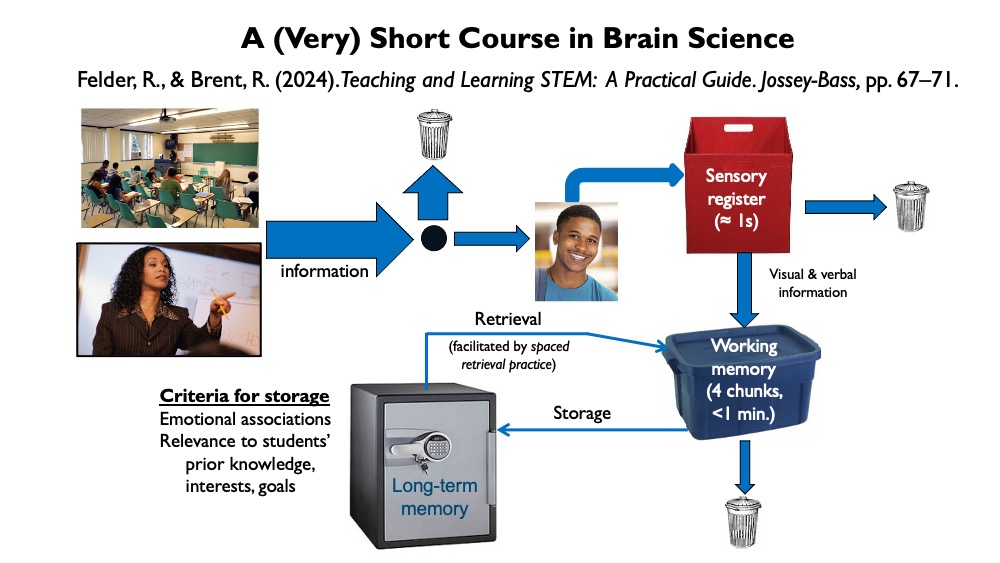
Figure 1:Spaced retrieval practice supports keeping information in the long-term memory. ©️Felder, R., Brent R. Source
- spacing effect
The spacing effect demonstrates that learning is more effective when study sessions are spaced out. Spacing effect
- diary
a place where you collect your reflections about your learning experiences in the course
- Discussions
The online board we use for online communication. https://
github .com /orgs /dtucprog /discussions - Legacy materials
Previous version of course materials https://
c -programming -legacy .aydos .de - accept
accepting an assignment in Classroom 50. It creates a repository which your instructor and you have access as default.
- deleting a file on GitHub
You left click (open) the file you want to remove and then click the
...on the right side of your screen: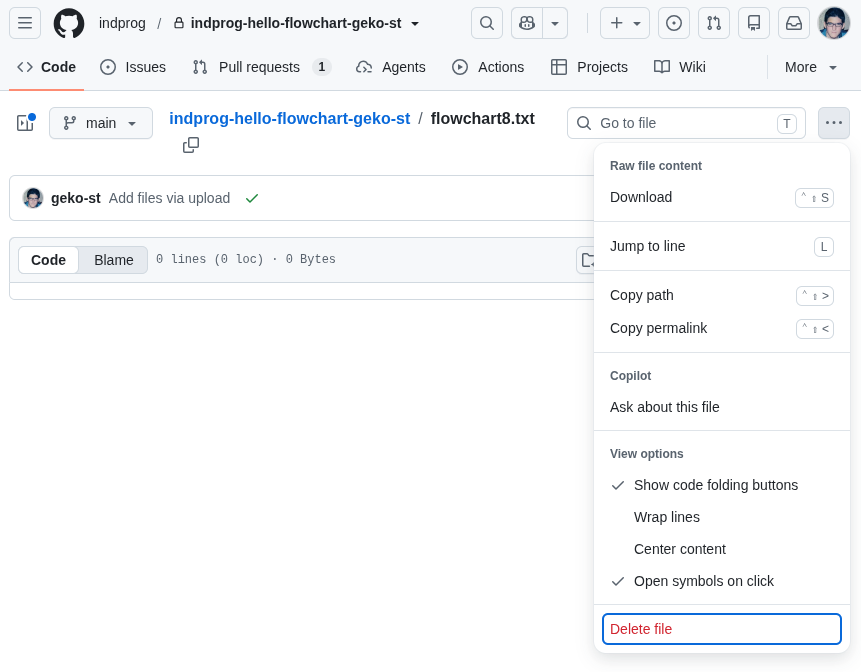
Figure 2:
Delete Filebutton on the right below.Then, click
Commit changes...- check
a program that runs in the background after you accept an assignment or do a change in your repository. An example is autograde.
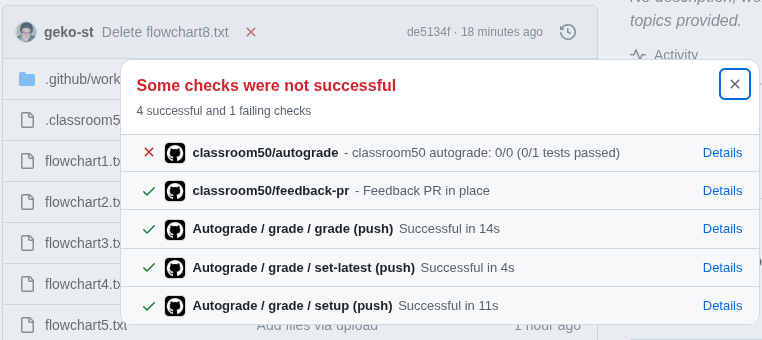
The autograde check has failed.
- autograde
a program that supports you and us to give feedback about your assignment. It usually consists of tests. Examples: testing whether the required files are present, testing whether your assignment outputs
helloifhiis input.- autograde results
Refer grade summary
- grade summary
autograde results can be seen by clicking
Detailson the respective check or clicking the last release.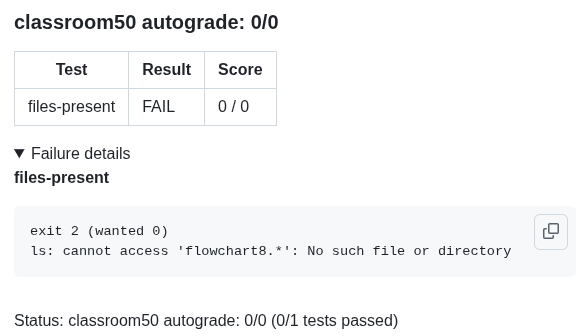
The test
files-presenthave failed. In the details we see the reason:flowchart8.*could not be found.If a test fails, then do not blame yourself! The test itself may have mistakes too 🙂.
- release
a version of your assignment which got submitted. The main page of your repository shows the last release:
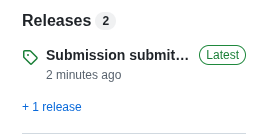
Releases section of your repository on GitHub. In this example it shows that you have submitted your assignment.
- declarative
Using text, you describe what a product, e.g, a diagram, program, should contain. The app figures out how to, e.g., draw it, write code, respectively.
- RAPTOR
- package manager
software tool that automates the process of installing, upgrading, configuring, and removing computer programs in a consistent manner. Package manager
It eliminates the problems with manual installations, which can be time-consuming and lead to errors.
- VSCodium
an editor based on the popular text editor Visual Studio Code (VS Code).
- loop
a control flow construct that performs iteration. Loop (statement)
- structured program theorem
states that any program can be combined in only three ways to get any larger task done. Structured program theorem
- sequence
executing one subprogram, and then executing another subprogram. drawing One of the big 3 of the structured program theorem.
- selection
executing a subprogram based on a certain condition. One of the big 3 of the structured program theorem Structured program theorem
- iteration
a step where some action is repeated again and again. Iteration. One of the big 3 of the structured program theorem.
- condition
an (Boolean) expression that evaluates to either true or false.
- creeper
a fictional creature from Minecraft. Creeper (Minecraft)
- feedback template
The following widget can renders the top text in the DEMO tab below. You can edit the text to see how your rendered table will look like.
You can use it later to give feedback to your peers.
- snake case
or
snake_casethe process of writing compound words so that the words are separated with an underscore instead of space. Snake case- camel case
or
camelCase, writing format practice of writing phrases with capitalized words and yet without spaces or punctuation. Camel case- PascalCase
initial upper camel case, e.g.,
OvenState,StateCamel case#Variations and synonyms- do-while
If your flowchart is as follows:
Then you can use a
do-while.- for
- compiler
a program that translates code written in one programming language into another. Compiler
- sentinel
A value that interrupts the current process.
Literally: a guard https://
en .wiktionary .org /wiki /sentinel. - zero-based numbering
- running total
- side effect
- brute-force search
- divide and conquer
- abstraction
Abstraction (computer science) List of abstractions (computer science)
- decomposition
- software reusability
- local variable
- function prototype
- argument coercion
- function call stack
- stack overflow
- pass by value
copying data and giving this as an argument to a function. Also called call by value: Evaluation strategy#Call by value
- pass by reference
giving the address of the data as an argument to a function. Also called call by reference:Evaluation strategy#Call by reference
- enumerated type
- storage class
- recursion
- peer instruction
- end-of-file
(EOF) End-of-file
- array
- element
a variable or value in context of an array
- variable-length array
- standard library
the library that always comes with a language. Like a swiss army knife, it includes functionality most developers use. For example: libC standard library, Python standard library. Standard library
- EAFP
easier to ask for forgiveness than permission. Preferred in Python. https://
docs .python .org /3 /glossary .html #term -EAFP - LBYL
look before you leap. Explicitly testing for pre-conditions before making any steps (leaps). Not preferred in Python but required in C. https://
docs .python .org /3 /glossary .html #term -LBYL - pointer
a variable whose value is a location in the computer’s memory. Pointer (computer programming)
- principle of least privilege
- radian
a unit of measuring angles (symbol: rad). Whole rotation is rad and a right angle (90°) is rad. Radian
- sequence (abstract data type)
a collection of items that are finite in number and in a particular order. List (abstract data type)
- list comprehension
a syntactic construct for creating a list based on existing lists List comprehension
- dictionary
a special kind of array, where each element has a name or label (key) instead of just a number (index). Also called associative array
- set
a data type that stores distinct values, without any particular order. Set (abstract data type)
- serialization
translating a data structure into a format that can be stored or sent over network. Also called marshalling, or flattening. Serialization
- object-oriented programming
way of writing computer programs using objects to stand for data and methods. In contrast to writing a list of instructions for the computer, telling it to do certain things in a certain way, which is called procedural programming. Object-oriented programming
- procedural programming
a language that follows instructions in a sequential manner. Mostly centered around functions. Procedural language
- blueprint
a technical drawing which usually contains instructions for how to build an architecture or engineering design. Blueprint
- class
basic building block in object-oriented programming defined to create an object. Analogy: blueprint. Class (programming)
- instance
(or object). An object created from a class type Instance (computer science)
- Unified Modeling Language
UML. A visual modeling language for visualizing the architecture and design of a system, similar to a blueprint. Unified Modeling Language
- class diagram
describes the structure of a system by showing the system’s classes. Class diagram
-means private,+public.Adapted from Source
- use case diagram
visualization of a user’s possible interactions with a system. Use case diagram
Example Another example:
Adapted Source
- bubble sort
a simple sorting algorithm typically used in teaching. Bubble sort repeatedly steps through the input list element by element, comparing the current element with the one after it, swapping their values if needed until no swapping is needed. The larger elements “bubble” up to the top of the list. Bubble sort
- stream
a sequence of potentially unlimited data elements made available over time, e.g., from a USB drive to computer’s main memory. Stream (computing)
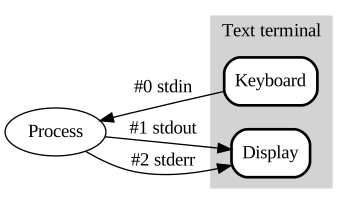
The three standard streams. Source
- token
a string that has been separated out from a larger text, and can be treated as a unit. Its meaning is assigned by whatever processes it. E.g., we can split “Hello world” sentence on the space character and get two tokens: “Hello” and “world”. We might then assign the word “Hello” the meaning greeting and world as a place name. Lexical analysis#Tokenization
- REPL
read–eval–print loop. An interactive programming environment that takes single user inputs, executes them, and returns the result to the user. A.k.a interactive toplevel, language shell. https://en.wikipedia.org/wiki/Read–eval–print_loop
- struct
(in C) A way to group different pieces of information together. Stands for structure. Struct
- tag
a name that follows
struct,union, orenum. instruct Person {},Personis the tag. https://www .gnu .org /software /c -intro -and -ref /manual /html _node /Type -Tags .html - linked list
a data structure where each item links to the next item. Their order is not given by their physical placement in the memory like in arrays. Linked list
- tagged union
a data structure used to hold a value that could take on several different types, where only one type can be in use.
tagexplicitly indicates which type is in use. Tagged union- anonymous struct
a C11 feature (compared to untagged structs). A member inside another struct with no member name, so its fields are accessed as if they belonged to the outer struct.
- bit field
a data structure that maps to one or more adjacent bits with a specific purpose. Bit field
- raylib
a video-game programming library https://
www .raylib .com - octal
a numeral system that uses the numerals 0 through 7. Prefix
0makes a number octal in C:0100= 64. Used to be more popular in early days of computers with character codes of 6 bits (old definition of byte), e.g., PDP-6, and with 12, 24, 36 bit architectures, e.g., PDP-8. Octal numbers still live in Unix file permissions. Octal- hexadecimal
a numeral system with 16 symbols,
0toF. Hexadecimal- two’s complement
a way of storing negatives. https://simple.wikipedia.org/wiki/Signed_number_representations#2’s_complement
- file
a means of store data that belongs together. Computer file
- file descriptor
an integer index provided by the operating system (OS), that is linked to a file table. File descriptor
- JSON
a data format. JSON
- polymorphism
allows a value or variable to have more than one type and allows a given operation to be performed on values of more than one type. Derived from the principle in biology, where an organism can have many different forms or stages. Polymorphism (computer science)
- event-driven programming
a method in which the program flow is determined by sensor outputs or user actions, e.g., mouse, keyboard. Event-driven programming
- graphical widget
in GUIs: an element of interaction, such as a button or text field. Graphical widget
- wireframe
screen blueprint. A visual guide that represents the graphical user interface. Website wireframe
draw.io includes wireframe shapes. Click + More Shapes and activate
Mockup- database
an organized collection of data or a type of data store based on the use of a database management system (DBMS) Database
- database management system
the software that interacts with end users, applications, and the database.
- SQLite
a lightweight database engine, and strictly speaking not a database management system like MySQL or PostgreSQL, but SQLite behaves similarly. SQLite
- SQL
a language used to view or change data in databases. Structured Query Language
- SQL injection
an attack, in which malicious SQL statements are inserted into a data entry field. SQL injection
- CRUD
create, read, update, and delete — the four basic operations of storage. Create, read, update and delete
- relational database
relational databases help users to join information to other information. In contrast to NoSQL databases. As of 2026, relational databases seem to be dominant[^stackoverflow-tech-data-2026]. Relational database
- NoSQL
databases that do not use relations. In contrast to relational database. Used for distributed data with huge data storage like Facebook. NoSQL
- database schema
the structure of a database in a formal language. Database schema
- primary key
columns that can identify each individual row in a table in a relational database. Primary key
- foreign key
attributes in a table that refers to the primary key of another table. Foreign key
- entity relationship diagram
describes interrelations between tables in a database. We use crow’s foot notation. https://en.wikipedia.org/wiki/Entity–relationship_model#Related_diagramming_convention_techniques
- row- and column-major order
methods for storing multidimensional arrays in computers. In row-major, the second row is stored after the first row, etc. Row- and column-major order
- Power Query
a data transformation and preparation tool by Microsoft. Python in Excel uses Power Query to import external data. Power Query
- comma-separated values
(CSV). Text data format for storing data you might find on a spreadsheet:
name, age, city Ada, 37, Istanbul Bilal, 84, Oran- pipeline
known from the Unix OS and available in all modern terminals. A mechanism for communication between programs. Pipeline (Unix)
Why Classroom 50 instead of DTU Learn? It eases the submission of Git-based projects for both the instructor and student. GitHub has many features, which lead to many mistakes for beginners. Classroom 50 locks many of these features and gives the ownership of the repositories to the instructor, which is one of the concrete advantages.